Doves are some of the most well-known game birds in the state. Dove hunting is a great gateway into the world of hunting and is enjoyed by thousands of Texans annually. It is important that hunters and land managers understand the basic biology and ecology of this popular game bird so that we can ensure they continue to be abundant in the in the future.
There are at least 8 species of dove in Texas, 2 of which are much more well-known than the others. The white-winged dove (Zenaida asiatica) and mourning dove (Zenaida macroura) are not only the 2 most popular dove species in Texas.
Identification
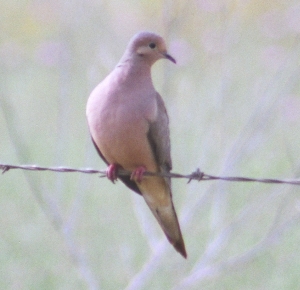
At first glance the mourning and white-winged doves look very similar, but several key characteristics distinguish them.
 |
 |
| Mourning Dove | White-winged Dove |
| Long tapered tail | Medium-long rounded tail |
| Slightly smaller than white-winged dove | Slightly larger than mourning dove |
| Faster wing beat, more erratic flight pattern than white-winged dove | Black wingtips, white bar on top of wings |
Distribution
Mourning doves are a nearly ubiquitous bird throughout North America, breeding in all of the lower 48 states and parts of southern Canada. The northern birds migrate south each fall to winter in the southern half of North America and Central America.
White-winged doves have a much more limited distribution than mourning dove, although it has been expanding in recent decades. Although historically white-winged doves were found primarily in northern Mexico, the Lower Rio Grande Valley, and the Big Bend region, their range has expanded northward and is currently found throughout Texas except for the Pineywoods.
Habitat requirements
Doves, like any animals, require food, water, cover, and space. Because doves have such a large distribution, the habitats they utilize to meet these requirements are varied. Still, some basic trends can be seen throughout their distribution.
Food
Mourning dove feed mainly on hard-coated seeds, which must be present on the surface of the ground because dove will not scratch or dig for food. This means that land owners who wish to attract doves to their harvested grain fields should not immediately till the fields. White-winged dove also feed on fruits (mast) in addition to the seeds that mourning dove prefer.
Rangelands can potentially be just as productive as croplands for doves. The key here is to promote early successional plants, which tend to have the hard seeds that doves are looking for. Early successional plants are plants (usually forbs) that first grow back after a disturbance such as fire or disking. One strategy is to disc strips over a 3-year period. For example, in year 1, strip disc an area 10-15 feet wide. In year 2, disc an adjacent area and another adjacent area in year 3. In year 4, due to the growth of vegetation it should be time to re-disc the original area.
Many people are interested in the use of food plots to attract dove to their land. However, some wildlife professionals have a saying along the lines of “when you need them, you can’t grow them, and when you can grow them, you don’t need them.” Basically, food plots have the greatest potential benefits when drought conditions cause native vegetation to fall short of the food requirements for residential and migrating doves. Unfortunately, since native vegetation is usually composed of the plants best adapted for the local climate, the chances of planted crops succeeding in drought conditions that caused native plants to die is unlikely. The exception is of course food plots that are irrigated. On the flip side, during normal or abundant rainfall years there may be enough native food sources present that food plots will be unnecessary. One option is to broadcast native forbs such as sunflowers on disked areas to create a native food plot that will be low maintenance.
The following is a list of some of the common seed producing plant species that dove prefer.
| Woody | Grasses | Forbs |
| Hackberry | Switch grass | Annual sunflower |
| Pricklyash | Panic grasses | Croton (dove weed) |
| Sumac | Plains bristlegrass | Western ragweed |
| Wolfberry | Yellow Indian grass | Pigweed |
| Bumelia | Snow-on-the-mountain | |
| Black Brush | Pricklypoppy |
Water
Water can be a major dove attractant, especially during drought years when shallow stock tanks dry up across the state. Water sources should be no more than 4 miles apart and deep enough to outlast droughts. Water sources located between roosting and feeding areas may see higher utilization by doves than water sources unassociated with feeding or roosting areas. There are several things you can do to make your water sources more attractive to dove:
- Make water troughs overflow a little bit so that doves can drink at ground-level
- Clear vegetation from around stock tanks, doves prefer exposed shorelines
- Situate water sources around a tall perch (tree or power line) or plant a tree near an existing water source that will grow into a good perch tree
- Floating platforms or ramps can make open water troughs usable for doves
Nesting
Mourning dove can be found nesting everywhere from man made structures such as light poles and storefront letters to trees and even the ground in some regions. They nest in isolated pairs, with both genders sharing nesting duties. Nests usually consist of 2 eggs. Incubation lasts for about 14 days. Squabs, as the young are called, are fed crop milk from both parents early on and then are weaned onto regurgitated seeds. Squabs can leave the nest after as few as ten to fourteen days, but remain nearby for a few more days. Depending on the weather, mourning doves can nest year-round, making up to 5 nesting attempts a year.
White-winged doves have similar nesting strategies, except they typically nest in colonies, only occasionally nesting in isolated pairs. Nesting sites can be anything from native brush to cultivated trees. They generally attempt 2 nests a year, with the nesting season lasting from April till July/ August.
Works Referenced
Taylor, B., D. Rollins, J. Johnson, J. Roberson, T. W. Schwertner, N. J. Silvy, and R. J. Linex. 2006. Dove management in Texas. Texas Cooperative Extension B-6185, College Station, Texas, USA.
More information is available in our Publications.
For hunting regulations visit: http://www.tpwd.state.tx.us/regulations/outdoor-annual/